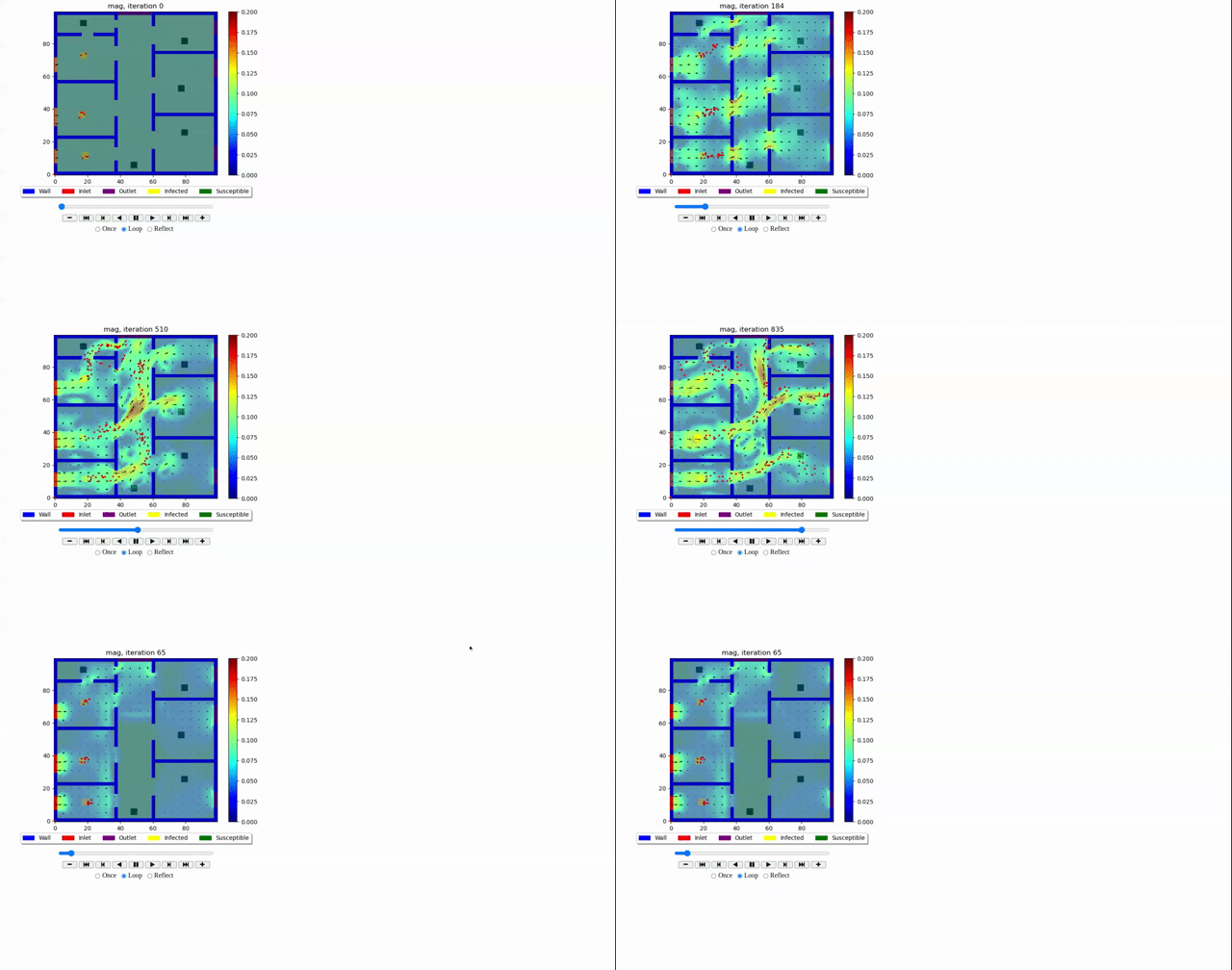
A simple lattice-Boltzmann implementation for 2D flow simulations with particle tracking.
Overview
This project presents a numerical simulation that models airflow and tracks virus particles in indoor environments. We researched the effects of opening and closing windows on particle concentration, addressing the question: What is the relation between the fraction of time that windows are open, and the number of particles in the system?
Method
We use the Lattice Boltzmann Method (LBM) with a D2Q9 lattice (2 dimensions, 9 velocity directions) to simulate airflow. The implementation includes BGK collision, bounce-back boundary conditions, aerosol tracking, and infection simulation. To model windows, we designate points as inlets (constant velocity) and outlets (constant pressure), which can be dynamically replaced by walls to simulate opening and closing.
Validation & Experiments
The method was validated using the lid-driven cavity benchmark, showing good agreement with reference data from Ghia et al. The simulation models a 30 × 30m hospital room section. While the physical Reynolds number would be ~202,000, we used Re = 300 for computational feasibility. The framework supports various experiments including lid-driven cavity, Karman vortex, and custom user-defined maps with configurable inlets, outlets, walls, and infection sources.
Results
The simulation tracks virus particles as a function of iterations, with windows closing at multiples of 500 iterations. This allows us to study the relationship between ventilation patterns (fraction of time windows are open) and particle concentration in the system.
Authors
Jeroen van den Berg, Erencan Tatar, Robbie Koevoets